It is scientifically proven that physical exercise is one of the greatest rehabilitation methods. Numerous studies consistently prove the indisputable benefits of exercise therapy.
Did you know?
People who are physically active for approximately seven hours a week are 40% less likely of dying early than people who are only active for less than 30 minutes a week.
So what are the health benefits of exercise?
Helps you control your weight.
Can help you develop positive and healthy social relationships (making friends, engaging with other children, self-expression).
Improves coordination and balance.
Improves posture.
Strengthens your bones and muscles, slowing down degenerative processes such as osteoarthritis.
Reduces your risk of falls.
Reduces your risk of some cancers, including breast, lung and colon.
Improves your mental health and mood.
Improves your sleep.
Any many many more!!
So what is stopping you?
Time – Time waits for no one. But there is plenty of it in the week to make a difference. Don’t fear moving slowly forward, fear standing still.
Knowledge – Starting is always the hardest part! Here at Physio Fusion we are always willing to help guide and advise you on all aspects of your physical health. We are very fortunate to have good connections with other healthcare providers who can also help to assist you!
Confidence – You have our vote! At physio fusion we embrace the lifestyle we promote. We are here to facilitate your needs and to guide and advise you on all aspects of your health.
Cost – Your health is your wealth. At Physio Fusion we provide the highest quality treatment and advice at very affordable prices.We have special rates for clients with a Gold Card (no co-payment) or Community Services Card ($10.00).
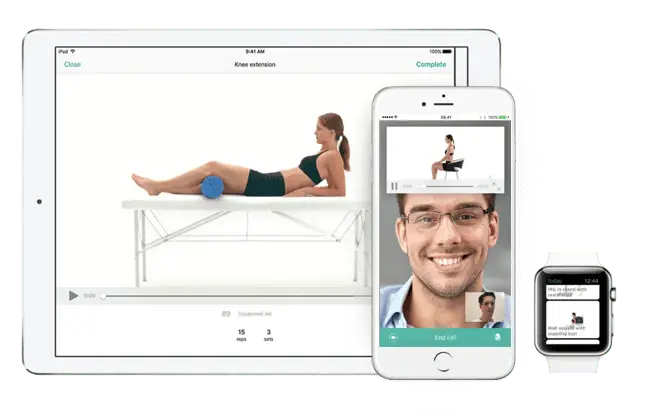
Distance – For those of you unable to travel to our clinics, or who are isolating currently due to COVID-19 we have you covered! We offer telehealth (online video) consultations, supported with a rehab exercise programme tailored to your needs via the online database Physitrack.
Secure your appointment today by booking online or phone us on:
Rotator cuff injuries are the most common source of shoulder problems. They can range from minor sprains causing impingement type symptoms, to massive tears resulting in severe loss of function and pain. They commonly occur as a result of acute injuries (sports, falls), chronic overuse (repetitive loading) or due to gradual aging.
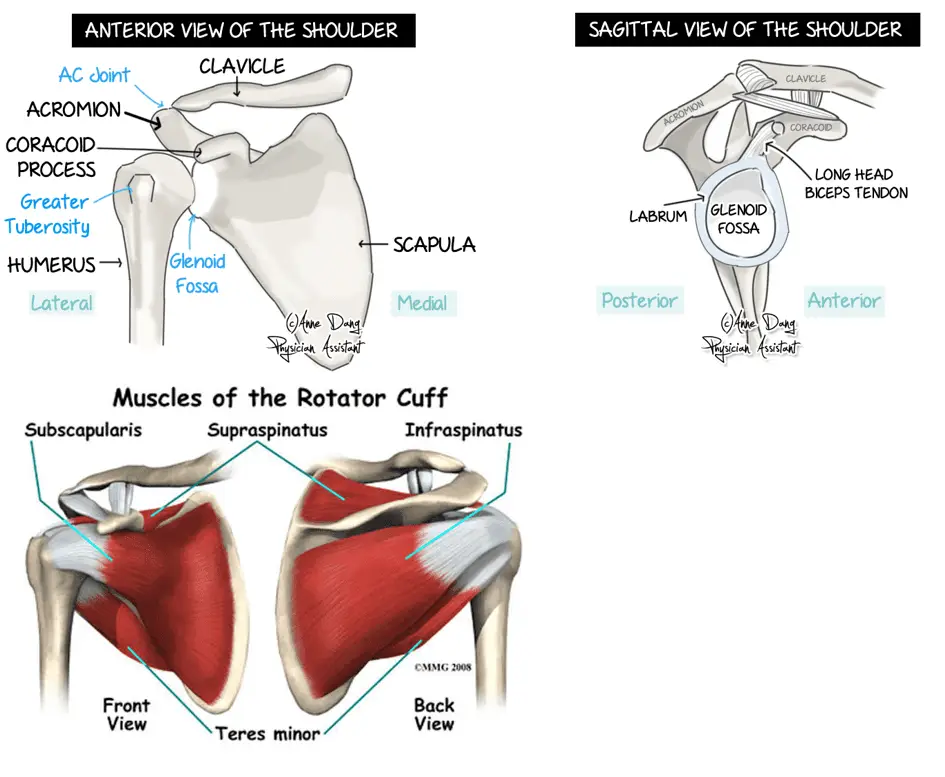
Anatomy of shoulder
The shoulder joint (glenohumeral joint) is the most mobile joint in the human body. It comprises of the humeral head (top portion of upper arm bone) which fits in the glenoid cavity of the scapula (shoulder blade) to create a ball and socket configuration. This anatomical configuration results in limited bony contact between the humeral head and the glenoid fossa, which reduces the stability of the joint.
Several passive and active structures stabilize and maintain proper biomechanics of the shoulder joint.
Passive stabilizers include the ligaments, joint capsule, cartilage and the bony concavity of glenoid fossa. Thick cartilage known as labrum lines the glenoid fossa to further deepen the groove by about 50% which is advantageous in stabilizing the shoulder joint during the articulation.
Dynamic stabilizers of the glenohumeral joint is gained from the coordination of rotator cuff muscles that compress the passive structures providing stability and mobility as whole.
The four rotator cuff muscles include:
supraspinatus
infraspinatus
subscapularis
teres minor
Injury to any or all these four muscles, including the tendons that attach the muscles to bone can result movement dysfunction and severe pain.
Other important joints of the shoulder complex include:
sternoclavicular joint
arcomioclavicular joint
scapulothoracic joints
Types of rotator cuff pathology
Acute rotator cuff tear
Acute tears result from sudden forceful lifting of the arm against resistance or in an attempt to cushion a fall (for example, heavy lifting or a fall on the shoulder).
Chronic rotator cuff injury
Chronic rotator cuff tears are the result of gradual wear and tear that occurs slowly overtime with pain persisting more than three months.
There are several factors that contribute to this which include: repetitive strains, bone spurs, poor healing rate due to age.
Tendinitis and Tendinosis
More often than not the term tendinitis and tendinosis are interchangeably used to describe a similar tendon pathology. However, the factor that differentiates the two is the time of injury (acute or chronic).
Tendinitis results from acute injury to the tendon which sets off an inflammatory process characterized by pain, swelling, and redness. On the other hand, tendinosis is a chronic pathology that does not involve an inflammatory process. It is characterized by degeneration of collagen fibers in response to persistent micro-trauma, vascular compromise and aging.
Signs and symptoms
Symptoms of a rotator cuff injury are due to the inflammation that accompanies the strain. Swelling that forms within the small space of the joint prevents the normal mechanics of the shoulder, resulting in the clinical picture of pain and decreased range of motion.
Acute rotator cuff tears
Tearing sensation Immediate severe localised pain Reduced strength Symptomatic clicking Reduced and worsening pain with movements Affects daily activities (personal care, lifting, reaching etc)
Chronic rotator cuff tears
Generalized deep dull ache, sharp onset of pain with movements Global shoulder weakness Reduced movements and daily activities (especially moving to the side, reaching behind back)
When to seek medical treatment
See your doctor or a physiotherapist if you experience any of the following symptoms in the shoulder:
Pain, especially pain that does not improve with rest
Swelling, redness or tenderness around the joint
Shoulder weakness
Reduced shoulder movement
Seek immediate medical attention if you experience the following symptoms:
Sudden, severe pain
Visible joint deformity
Inability to move or use your shoulder joint
Sudden swelling, discoloration
Diagnosis
To diagnoses an injured rotator cuff, your physiotherapist will begin with a thorough subjective and physical examination of your shoulder.
Subjective assessment
Your physiotherapist will begin with a thorough subjective assessment inquiring about your signs and symptoms of an acute injury as well as any symptoms that may suggest a more long-term problem.
Physical assessment
The physical examination often involves observation to look for muscle wasting, deformities, and/or changes in appearance of the injured shoulder to the unaffected side. Your physiotherapist will also palpate different areas of the shoulder complex to find the area of pain or tenderness. Further examination will involve assessment of movement and strength to establish injury to muscles or tendons.
Radiology
In addition, your physiotherapist may refer you for imaging tests to diagnosis the cause of your symptoms:
MRI: provides detailed imaging of areas injured (referred by doctors, specialists or surgeons)
Treatment
Early diagnosis and treatment of a rotator cuff tear may prevent symptoms such as loss of strength and loss of motion from setting in.
Initial treatment of rotator cuff tendinitis involves managing pain and swelling to promote healing. This can be done by:
avoiding activities that cause pain
applying cold packs to your shoulder three to four times per day
taking anti-inflammatory medications like ibuprofen and naproxen
Rehabilitation plays a critical role in both the nonsurgical and surgical treatment of a rotator cuff tear.
When a tear occurs, there is frequently atrophy of the muscles around the arm and loss of motion of the shoulder. An individualized physiotherapy program is necessary to regain strength and improve function in the shoulder.
Physiotherapy
Physiotherapy will initially consist of passive exercises to help restore range of motion and ease pain.
Once the pain is under control, your physiotherapist will prescribe exercises to help regain strength in your arm and shoulder.
Steroid injection
If you have persisting symptoms, your physiotherapist may recommend a steroid injection. This is injected into the tendon to reduce inflammation, which reduces pain.
Surgery
Surgery is recommended if you have persistent pain or weakness in your shoulder that does not improve with nonsurgical treatment. In which case, your physiotherapist will refer you to surgeon for an opinion of surgical intervention.
Exercises
Remember to consult your physiotherapist for precautions before starting or when progressing the exercises.
Range of movement exercise
Pendulums
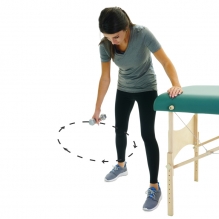
Lean forward with one arm hanging freely. Use your unaffected arm to brace against a chair for support.
With your affected side, gently swing the hanging arm from side to side, forward and back, and in a circular motion for 15-20 seconds each direction.
Slowly return to a standing position.
Repeat 4-5 times a day
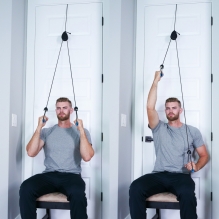
Shoulder pulley (Flexion)
Put a chair against the door and sit so you are facing away from the door.
Grasp the door pulley handles with both hands.
Pull down on the pulley with your unaffected arm. This will lift your injured arm up over your head. Pull it as high as you can.
DO NOT FORCE THE MOVEMENT. Your affected arm should be relaxed. The unaffected arm does the work.
Hold for 5 seconds. Relax and repeat 10-15 times, 3 sets. Three times a day.
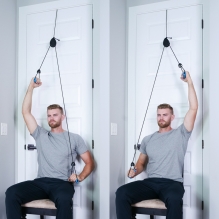
Shoulder pulley (Abduction)
Put a chair against the door and sit so you are facing away from the door.
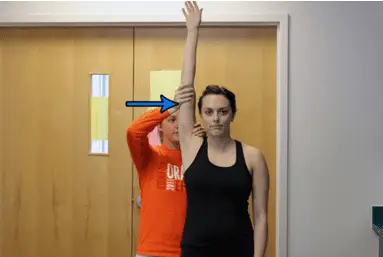
Using door pulleys slowly pull down with your unaffected arm so that your affected arm raises up and to the side without effort.
Your affected arm should be relaxed. The unaffected arm does the work.
Hold for 5 seconds. Relax and repeat 10-15 times, 3 sets. Three times a day
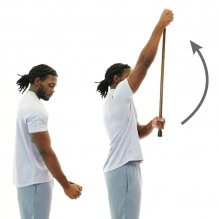
Wand flexion
Stand upright and hold a stick in both hands
Cup the top end of stick with affected hand
Using your unaffected arm hold the stick midway and drive the affected arm forward and up.
Ensure your elbow is straight throughout
Hold for 5 seconds and return to the starting position. Repeat 10 times.
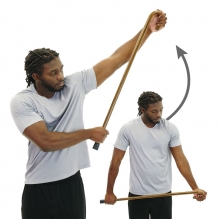
Wand Abduction
Stand upright and hold a stick in both hands
Cup the top end of stick with affected hand
Using your unaffected arm hold the stick midway and drive the affected to the side as high as able.
Ensure your elbow is straight throughout.
Hold for 5 seconds and return to the starting position. Repeat 10 times.
Strengthening exercises with band
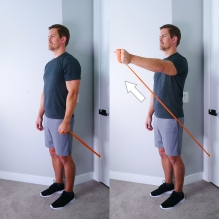
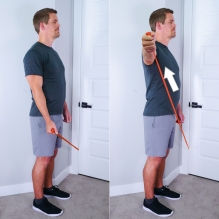
Flexion
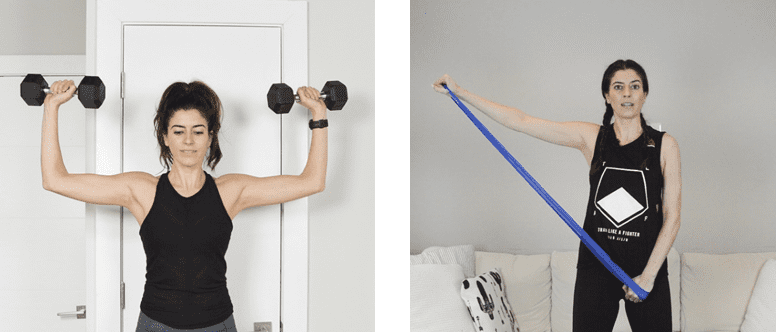
Stand on one end of the band while holding the other end with your affected side.
Whilst keeping your elbow straight, lift the band up to 90 degrees to shoulder level.
Hold at the top for 1-2 seconds then lower slowly to starting position.
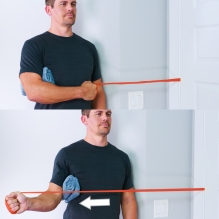
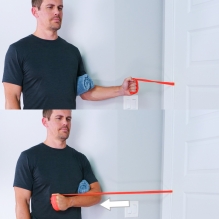
Attach the resistance band to a secure anchor at belly button height.
Stand with unaffected arm perpendicular to the anchor.
Place a towel between your elbow and your torso to stabilize your elbow
Grab the band using your affected side and then slow pull the band away from your body by squeezing your shoulder blade in towards the middle of your back.
If your answer is YES, then be assured that you are not alone.
The fact is that with today’s technological advances most of us spend anywhere from 6 to 8 hours a day sitting at our desks working on a computer, laptop or mobile devices whether this is part of your work, study or simply spending leisure time.
Sitting for long hours at a time makes it extremely difficult to maintain proper posture. That’s because we are not made to for it, so many of us have the tendency lean forward, slouch our shoulders and hunch our backs. The unfortunate consequence of restoring to this kind of improper posture is the increase in unnecessary stress on multiple areas in your body including the neck, shoulders, back and arms resulting in pain and discomfort.
Adapting to poor posture on a repeated basis can affect your health and overall performance.
What are the effects of poor posture?
Poor Joint Alignment
Increased muscle tension
Increase joint compression
Reduced blood flow
Reduced lung expansion resulting in poor oxygenation
Fatigue
Reduce performance
How to fix it?
Fortunately headaches, neck pain or back pain caused by poor posture can be fixed with the following preventative measures:
1. Ergonomics
You may have heard of the term, ergonomics. To put it simply, ergonomics is a scientific discipline that aims to create sustainable workspace or environment to optimise productivity while maintaining health and safety standards.
Creating a sustainable work space environment begins with personalizing the setup of your desk, chair and equipment. Here are a few tips to keep in mind.
Ergonomic Chair Setup: Sitting
Adjust your chair There is no one-size fits all, so it is important to make your chair ergonomically fit for you.
Balanced posture. Sit well back into the chair with an upright and balanced posture.
Neutral spine. Slightly tilt the backrest forward to rotate pelvis so spine is in neutral position. You may intermittently recline back ever so slightly to offload your back.
Hips high, feet flat. Adjust height of your chair so your hips are slightly higher than your knees, feet are resting flat on floor and at hip width apart. You may use a foot stool as an alternative if necessary.
Sit close. Scoot your chair close to the desk with little space left between the desk and your stomach
Ergonomic Desk Setup: Sitting
Arms reach. Organise your frequently used stationary so that they are arms reach away.
Keyboard. Position keyboard directly in front of your body.
Elbows off. Keep elbows close to your body resting on the hand rests but off the desk. Only the muscular aspect of your forearm makes contact with the desk.
Stable neck. Setup your desk so as to limit excessive head movements.
Main monitor. Working with two monitors can be tricky, so use one as the primary monitor. Ensure monitor is centered and positioned at arms length. Height of the monitor should be adjusted so the top one third of the screen aligns with your line of vision
Ergonomic Desk Setup: Standing
Posture. Stand tall, balanced and with your shoulder relaxed. Position your feet hip width apart for a strong base of support to anchor the weight of your upper body. Ensure you do not hyper-extend at your knees.
Elbow height. Elevate your standing desk to your elbow height.
Bend your elbows to 90 degrees. Ensure elbows remain off the desk, only the muscular aspect of your forearm makes contact with the desk.
2. Time for a Micro-breaks
No matter how ergonomically perfect your desk set-up may be it is important to take micro-breaks frequently.
There is mounting research that has found that taking frequent, short micro-breaks can be just as taking long breaks, if not more beneficial.
So do not be afraid to stand, walk or stretch for 1-2 minutes every 30 minutes.
3. Desk stretches
Keep yourself flexible with the following stretches.
Cross body stretch
Stand upright and prepare to start the shoulder stretch exercise.
This exercise stretches the muscles in your upper arm, upper back and shoulder and can be performed either sitting or standing.
Move your arm across your chest at the height of your shoulder.
Use your other hand to gently hold your elbow and pull the arm a little further across.
You should feel the stretch across the back of your arm and shoulder.
Hold this position and return to the start position and repeat to the other side.
Back stretch
Stand with your legs at hip width apart and straight.
Place your hands on your hips.
Lean your body backwards, trying to arch in the lower back as much as you can, lifting your chest up towards the ceiling.
Try to avoid allowing your hips to swing forwards too far.
Hold this position before returning to the start position
Side stretch
Stand with your feet shoulder width apart and place one hand on your hip.
Extend the other hand into the air, leaning over to the side while you increase the stretch by pushing your hips in the opposite direction.
Hold this position before you repeat on the other side.
Chest opener
Start in a standing position.
Move your arms behind you and interlock your fingers and move your arms slowly upwards.
As you lift your arms upwards you will feel a stretch in your chest and shoulders.
Hold this position, then breathe out and relax.
Side neck stretch
Place one hand behind you in the curve of your lower back, and the other by your side.
Now, bend your neck so that your ear comes closer to the shoulder that is opposite to the arm behind your back.
Hold this position for 30-60 seconds.
Trunk rotations
Stand up straight with your feet shoulder width apart.
Place your hands together and stretch your arms out straight in front of you.
Keeping your hips pointing forwards, rotate your arms from one side and then to the other.
Your feet should remain on the floor throughout the exercise.
Try to feel the rotation coming from your mid to upper body.
Still having pain?
If you are still experiencing pain and discomfort it is recommended to consult a Physiotherapist.
A physiotherapist will assess your cause of pain and provide you with a comprehensive treatment that is correct for you.
The Health Resources Services Administration defines telehealth as “the use of electronic information and telecommunications technologies to support long-distance clinical health care, patient and professional health-related education, public health and health administration. Technologies include videoconferencing, the internet, store-and-forward imaging, streaming media, and terrestrial and wireless communications”.
Here at Physio Fusion, we will be conducting video consultations for existing and new clients. You will see the same, experienced staff as you would on site at either our New Windsor Branch. With the exception of the hands on aspects, we strive to continue to provide you with the same level of education, advice and exercise progression as you would receive in person.
Telehealth Benefits for Patients:
Better access to services for residents/ workers in remote areas (Al-Shorbaji 2013, Bourne et al 2017, Cooper & Allen 2017, Nelson et al 2017) found that this can improve access to care services for clients in isolated areas and virtual consults can address access barriers for patients living in rural locales.
More convenient access to services (people avoid the travel and scheduling challenges of attending face-to-face appointments and can access some services after-hours).
The ability for patients to ask quick questions without having to book a full consultation
Access to high-quality online resources, including videos and digital tools
Telehealth benefits for Physiotherapists:
Access to an untapped pool of clinical resources: (Hunt et al 2014): Virtual health programmes offer benefits to clinicians who are looking for increased flexibility in their working life (e.g. semi-retired clinicians or those seeking an improved work/life balance). If offered, this may enable healthcare providers to attract and retain a high-quality workforce, improve staff satisfaction, and access highly specialized resources to improve quality of care.
What is Physitrack and how does it work?
Physitrack is an exercise prescription platform that lets you prescribe home exercises to our clients. It is a program that you as a customer can download for free on your smartphone, tablet or open it with your computer. The videos show how you can perform an exercise correctly and clearly. There are also more than 90 standard exercise protocols and videos with clear explanations about specific complaints or conditions.
How does it work?
Together we determine which exercises are most suitable for you and add these to your program. You will then receive an email with the link to download the Physitrack / app and the link to the program online. Your personal login code is also stated in the same email. If you have downloaded the Physitrack or clicked on the link and enter your password, you can enter your preferences in the program, such as setting reminders. Then you can start with the exercises in a correct and clear manner and contribute to your own recovery!
The attached document is designed to help you prepare for your Telehealth call. PhysiApp_Telehealth_call
What will happen once my appointment is booked?
Your Physiotherapist will send an email with more details on how the consultation will take place.
Before your appointment you will receive another email from Physitrack with a link to where the consultation will take place.
Make sure that you have a working camera and microphone.
Make sure you’re using a modern browser, such as Chrome, Firefox, Safari or Microsoft Edge.
If you are using a mobile device for your consultation, you will be prompted to download Physitrack app Please do this and then click join as a guest.
We ask that you get online 10 minutes before your appointment and click on a link to join the consultation.
If you are using a computer, make sure your camera and microphone are available and enabled.
Please ensure that you have enough space in case you are required too perform exercises.
What happens if internet is interrupted or my technology fails during the consultation?
If we can call you, we will attempt to continue and complete the consultation via face time.
Here’s how to book your first Telehealth Consultation with us
Save time and book your appointments online with Physio Fusion 24 hours a day, 7 days a week. You can book your appointments via phone or online
The shoulder is made up of two joints. These are the acromioclavicular joint (collar bone meets shoulder blade) and the glenohumeral joint (upper arm meets shoulder blade). The shoulder is protected by ligaments (joining bone to bone) and muscles known as the rotator cuff. These muscles form tendons (joining muscle to bone) and play a major role is stabilising the shoulder. Under some of these muscles and tendons, there are small fluid filled sacs ((known as bursae) to allow easy gliding of muscles over bone. The upper arm also joins the shoulder blade with the help of the Labrum (soft tissue around the glenoid cavity). Finally, this is all surrounded by a fluid filled sac which lubricates the shoulder joint for better movement known as the shoulder capsule.
History taking and assessment
You can expect questions regarding the history of your shoulder injury from your physiotherapist such as:
How the injury happened
Where the pain is in your shoulder
Whether you have a ‘dead arm’ feeling
If you feel a different sensation from the other side or some weakness
Aggravating and easing activities
Past history and family history of shoulder injuries or pain
Once these questions have been asked and answered, your physiotherapist will proceed to perform an assessment of you and your shoulder. This can range from:
Posture assessment
Strength and sensation testing
Testing of ROM (movement of the shoulder)
Special testing to check joint stability, muscle integrity and possible signs of shoulder damage
Investigations
Based on your history and examination findings, your clinician will suggest the best possible investigation for you.
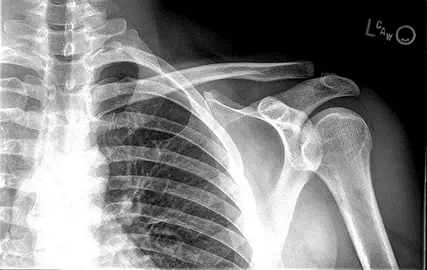
In most cases, initial X – rays are done to rule out broken bones.
Ultrasounds can be used to diagnose some ligament and tendon damage such as rotator cuff tears.
MRI is the best form of imaging but this does come at a higher cost and higher exposure to radiation. The MRI scan can identify bone, ligament and tendon injuries in the shoulder.
A CT scan is not usually performed in cases of the shoulder.
Possible injuries to the shoulder
Instability:
If you have dislocated your shoulder in the past or continue to experience shoulder dislocations, you may have some instability of the shoulder. Normally you may develop a “dead arm”. You may also feel a sense of heaviness, numbness or an inability to move the arm which persists for a few minutes. If you are experiencing these episodes more frequently with less force, it is advised that you see your healthcare professional.
Treatment:
Non-surgical management involves a period of rest with a parallel shoulder strengthening program for stability. This is done when the injury is acute and non-recurrent.
Surgical management is opted for when there has been damage to the ligament and Labrum as well as ongoing recurrence of shoulder dislocation. Surgery is associated with a reduced rate of recurrence.
Rotator cuff:
The four muscles that make up the rotator cuff are Supraspinatus, Infraspinatus, Teres Minor and Subscapularis. Rotator cuff injuries are one of the most common disorders of the shoulder. It is believed that most of these injuries are caused by overuse of the shoulder. Often heavy lifting, sports involving the shoulder and repetitive shoulder movements are associated with rotator cuff pathology. These injuries cause pain and stiffness with overhead activity (eg: throwing a ball or putting a shirt on) and pain is worse at night. You may also feel some weakness in your injured arm because of pain.
Treatment:
A partial thickness tear in the rotator cuff can heal with non-surgical management. These are managed with physiotherapy exercises, corticosteroid (cortisone) injections and most importantly, time. It is important to know that the pain will improve over time.
A Full thickness tear in the rotator cuff will normally be managed with surgery. This is followed by immobilisation of the arm for up to 6 weeks in a sling. After these 6 weeks, you should begin a physiotherapy program in order to aid your recovery.
Acromioclavicular joint (ACJ):
This is a fairly common injury and normally occurs in athletes involved in contact sport or when falling directly onto the point of the shoulder. You may experience some pain and swelling in the upper shoulder. This pain can sometimes occur with no reason at all and it is important to voice this to your clinician.
Treatment:
You will be treated surgically or non-surgically according to the severity of your injury.
Non-surgical management includes a brief spell of rest and sling use for protection and healing. This is followed by early mobilisation of the shoulder and a subsequent strengthening program. Your physiotherapist can also assist you with taping in order to return to activity.
Surgical management is followed by a physiotherapy program as outlined by the shoulder surgeon. This is normally done for a quicker return to play in contact sports or when pain is severe and a trial non-surgical management has not worked.
Fractures:
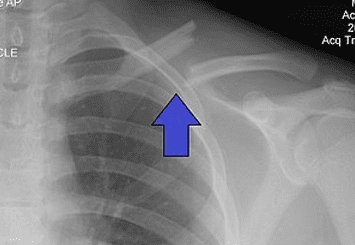
These normally occur as a result of direct trauma to the arm such as a fall. They can be very painful and are usually associated with a lot of swelling around the area.
Treatment:
Depending on where and how severe the injury is, the doctor may opt for surgical or non-surgical management.
In either of these cases, you will undergo a period (6 weeks maximum) of immobilisation of the upper limb to allow for healing. At the end of this period, it is important to see your physiotherapist to begin rehabilitation of your arm.
What to expect
Acute phase:
Immediately following an injury, you should be offered adequate pain relief. A sling can be very effective and can be combined with simple analgesia, anti-inflammatory medications and ice therapy.
Passive range-of-motion (ROM) exercises, including pendulum and active-assisted exercises, should be considered. You will be encouraged to maintain fitness (if comfortable) using a stationary bike or general walking.
Early Rehabilitation phase:
When your pain has settled and your ROM has improved to 60-70% of the unaffected side, you can progress with rehabilitation.
Exercises that might be useful in this phase include:
Stretch of the shoulder
Progressive ROM exercises with the goal of achieving full ROM
Strengthening of the rotator cuff and scapular stabilisers
Late Rehabilitation phase:
You will progress to this phase when you have a normal (full and painless) ROM and 75% strength of the unaffected side.
The types of exercises that might be useful in this phase include:
Progressive multi-planar exercises
The addition of further resistance exercises, including weights and the use of medicine balls and more functional activity
Plyometric exercises
Return to sport:
When you have a normal range of motion and more than 90% strength of the uninjured side, you can progress to return to sport. This should be done in a gradual manner.
A return-to-sport programme may involve:
Initial unopposed training
Opposed training in a controlled setting
Match practice
Return to sport when this full progression has occurred
In conclusion:
Your shoulder injury will be treated and tailored to you. With most shoulder injuries, physiotherapy can be helpful in operative and non-operative management.
Early management or rehabilitation of your injury could go a long way in speeding up your recovery process and avoiding re-injury in the future.







 Stand tall, balanced and with your shoulder relaxed. Position your feet hip width apart for a strong base of support to anchor the weight of your upper body. Ensure you do not hyper-extend at your knees.
 Elevate your standing desk to your elbow height.